Dear brothers and sisters!
Glory to Jesus Christ!
Good evening!
Today he is really good!
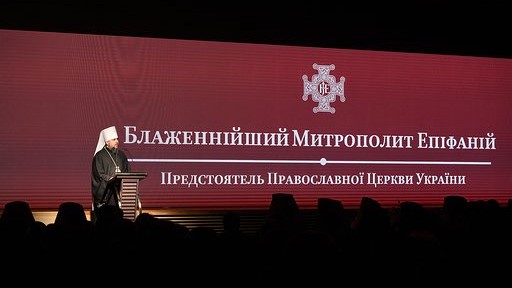
I am touched that so many people responded and came here for our meeting, so that we could all talk together about our Church, about its future, about Ukraine. About the things that Christian love and service to our neighbors motivate us to do.
We are all different in this room. Each person was created by God as a unique person. That is why we can differ in views and beliefs, tastes, interests, attitudes toward politics, and many other things. God has endowed us with different talents that we realize in different areas. But at the same time, all of us as children of God are one. We are all brothers and sisters to each other. We are all one human family. Also, all of us, regardless of place of birth or whether we live here or thousands of kilometers away, are united by love for Ukraine, indifference to its present and future.
In the story we all come from, everything was as it was. There were pages of suffering and victory, terrible trials and martyrdom, divisions and confrontations, but also – unity and progress, glorious accomplishments and heroism. There were sad and happy moments. And even if we want to, we can’t change what has already happened, but we have an influence on which way we go next. And I want to say that we are building a Church that accepts people as they are, to give everyone the opportunity and the means to be better; A church that does not stand in the way of God, but invites everyone to cross the threshold of the temple; A church built on love.
The Orthodox Church of Ukraine is open to all. And this, as young people say, is our main point of difference.
The church should and wants to be where it is needed: in the center of wealthy Kyiv and in the poor suburbs of a small town; on the noisy street of the metropolis and in a small rural community; in Donbass and Galicia, over the Dnieper and in the Crimea, in Transcarpathia and Odessa, where I was born, and in Bukovina, where I grew up; among the rich and the poor; among those who dial a phone number by pressing buttons, running a finger across a smooth screen, or even turning a dial. Wherever there is faith, and wherever there are people who identify themselves with the Orthodox Church of Ukraine.
Today we are in a situation where opinion polls show that more people belong to the local Orthodox Church of Ukraine than there are our parishes to which they can come. Most barriers are artificial barriers. They are designed to provoke conflicts, to divide people. We see how skillfully these traps are set.
In our ministry, we cannot respond with force to force, hatred to hatred. Our path is not a way of doing harm, but a way of forgiving and building trust. It is a long way that for the whole local Church can last longer than the life of each of us, but it is the way that the Lord Jesus Christ has shown us and that He has blessed us with.
A year ago, we restored unity and continued our progress. This is the path that began on these Dnieper hills, where we are now with you, St. Vladimir the Great more than a thousand years ago. This is a path that was interrupted but did not stop.
I was conciliarly elected the first Primate of the universally proclaimed, recognized autocephalous Orthodox Church of Ukraine, but I had more than a hundred Kyiv hierarchs in this department. A year ago, our Orthodox Church took its place in the Diptych as autocephalous, and therefore itself is responsible for its ministry and for its decisions. These decisions in their influence and consequences go far beyond the temples. In Ukraine, the Church is part of the central pillar of society. The autocephalous Ukrainian Church has never been a threat to Ukrainian society, but the Church, which was losing its Kyiv-centric, Ukrainian identity, was being turned into an instrument in the hands of the imperial state.
Ukraine must defend itself from aggression. Hundreds of chaplains from the Orthodox Church of Ukraine serve among the Ukrainian military defending Ukraine. Our priests are where there is pain, where there is a challenge, where there is a need for charity or charity. They share with society its anxious and joyful moments. They must be involved in people’s lives and understand it in all its diversity.
How to create a happy and strong family, find your vocation and build a career, give advice to condominiums, how to deal with the land market, manage the family budget, pay taxes, serve in the army, prepare for external evaluation, go to work and return home? These are all issues that concern Ukrainians. The Church cannot and should not substitute for their decisions and cannot be an expert in every matter, but the Church can and should be present as a counselor, as a friend, as a mentor and pastor.
Our task is to educate a person spiritually, to purify the human soul through the sacraments, to help to implement the Law of God in one’s own life, so that not through fear, by order or compulsion, but due to acquired spiritual experience and acquired knowledge, man and society find the right answers. they are worried.
In the history of Ukraine, it is difficult to find an institution that would be more supportive of the Ukrainian people than the autocephalous Ukrainian Church. As a loving mother, she opens her arms to all her children.
However, the Church is relevant not only in terms of tradition. The Open Church was and can be the center of the meeting of geographies, times and worlds. The Orthodox Church of Ukraine is an opportunity to interact with colleagues from other Orthodox Churches, because we are a local part of the one Church of Christ. The word “Eucharist”, translated from Greek as “thanksgiving”, defines the principles of common service, communion between the Churches in the unity of faith and sacraments.
Today we express our gratitude first of all to the Mother Church of Constantinople, the second in honor of the Patriarchate of Alexandria, the Church of Greece, the monasteries of the Holy Mount Athos for this unity and support. Believers of the Orthodox Church of Ukraine made numerous pilgrimages this year.
This is the restoration of ties that in the days of the holy princes Vladimir the Great and Yaroslav the Wise opened to our ancestors the treasures of the spiritual and material culture of the Greco-Roman world; ties that continued through fraternal schools, through academies founded by Saints Prince Constantine of Ostroh and Metropolitan Peter Mohyla.
The church was the main carrier of international relations long before the word “globalization” appeared. Today, the recognition of the Orthodox Church of Ukraine is a process that continued equally fruitfully last year before and after the political elections and continues, because this process is spiritual, not political, although it also has a political dimension for Ukraine, affirming its identity and sub objectivity.
This is just the beginning. Last fall, I traveled to the United States, where I received the Patriarch Athenagoras Award for Human Rights. The media, professional and political interest with which the Orthodox Church of Ukraine was met in the United States means understanding the importance of the role of our Church in the life of Ukrainians, and therefore for the future of Ukraine and Europe.
Both in Washington and a few days ago in Kyiv, we met with US Secretary of State Mike Pompeo, talked about the rights of those who found themselves under the oppression of the occupation in the Crimea and Donbas, the rights of all people, not just those who would go to our temples. This is another open door of the Church, in particular for the complex processes of peace-making, the release of prisoners and captives from foreign captivity, deoccupation and reintegration.
The Orthodox Church of Ukraine is a Church that passes all trials together with its people; it is the Church, which at the moment when our country is in trouble, must be and is with the people. A high level of trust in the Church also means a high level of responsibility. The Church shares the dream of every Ukrainian and previous generations – to see Ukraine as a place of dignified and happy life for everyone, but the road to this dream lies through daily work, through, as Winston Churchill said, “blood, work, tears and sweat.” Although he said this about the war with an external enemy 80 years ago, such a vision is always relevant for the Church, because the fight against evil in ourselves and in the world around us is our daily task.
The church must raise the question of how the state of our souls affects how our hands or heads work. How honest and conscientious are we? How productive? Can we do better? Are we capable of more? Can we reach heights not in the mode of heroic efforts, but planned by daily work? The Church has an influence on the formation of a culture of behavior in all spheres of life, and must be more active in this area.
After many decades and even centuries of despair, looting, unprotected rights, we must begin to learn to invest in the long run, to be more strategic, to do our job better, to care about the end result. Our doors are open, in particular for the difficult conversation about ourselves, about how to get out of the inertia of suffering, addiction to pain, traumatic trauma, the expectation of betrayal.
One of the most difficult conversations that awaits us is the family and family values. I hear many calls to protect family values, and they resonate in my heart. At the same time, we must understand that values are not created by directives and are not protected only by regulations. They are brought up and they are experienced as an experience. If a person has been abused in the family, it will be difficult to tell him only about strengthening the family as the greatest value.
We need to understand how to protect love and dignity in the family, how not to despise the sacrament of Marriage, how to help families strengthen the foundation of their security. Demographers say that the crisis of low birth rates and high mortality rates in Ukraine is becoming a challenge to the strength of the Ukrainian state itself. There are no more than 52 million of us. And although we cannot say the exact number, we must break the imperial Russian and Soviet legacy of human life as a expendable resource.
Every life is a gift of God, and its appearance and growth in peace and grace are possible when there is love. A strong family is also people’s respect for each other, it is a constant thought for the good of another, it is emotional health, it is good physical shape, it is the absence of addictions and abuses. We can and should talk about the family in the context of modern society. Then it will become clear where migration is really labor, and where it is an attempt to escape from oneself. How to make sure that children do not grow up without parental care? How to make parents not afraid of children, not afraid of losing themselves in worries, not afraid of losing the quality of life, not afraid of responsibility and not only in family matters?
The church is open to conversation and exchange of views, having its own voice and position.
The dreams of many Ukrainians of rapid prosperity are often a reaction to the fear of poverty. In recent decades, millions of Ukrainians have undoubtedly improved their living conditions, although in many respects we are still far behind the most developed countries in the world. Communal apartments, the absence and inaccessibility of basic household items, equality in poverty, in which millions of Ukrainians lived 2-3 generations ago, are a thing of the past, as are hand washing or lack of access to radio, television or telephone. Most Ukrainians have clothes or shoes that previous generations could only dream of, eating foods that their ancestors did not know about.
Sociologists are told by Ukrainians that they are becoming wealthier, but continue to assess their condition as socially vulnerable. We need to start talking about how to learn to recognize the changes that are happening within and around ourselves; how to stop accumulating thoughtlessly; how not to become dependent on status attributes; how to be more self-sufficient and be able to get joy from simple things; how not to despise love through bright packaging.
Our Church is open to dialogue with wounded souls, so that with God’s help everyone can find themselves, nurture the best and fight against the worst.
The other side of the vulnerability is the attempt to protect oneself through status. The desire to gain power is often a reaction to vulnerability. Then power is not perceived as the Lord teaches it, that is, it becomes dominion, not service. And it is not about individual people, but about a generalized challenge that affects the whole complex of relations between the state and the citizen. Power as domination, despotism instead of leadership has no prospect of any other reaction of the people than the revolutionary resistance, the Maidan. And society today is in a state where it cannot afford to go through new upheavals, new victims, new confrontations, even with good intentions, without fatal consequences.
This means that it is time to rethink leadership as a service, as a contribution to the common cause. How to make it easier to serve those who want to serve? How to protect leadership without despising those who cannot or do not want to be a leader? How to detect arbitrariness in time and not allow it to become a threat? The Church is open to dialogue and to finding better answers.
These are some of the challenges we face, but will follow. What will happen to the climate and nature? How not to waste energy? How to learn not to harm the environment? How do we conserve resources, that is, fulfill our duty as given by the Creator to care for nature, using its riches, rather than greedily destroying it? How to think about sustainability, look ahead to the years and calculate your steps? These are frequent anxieties of young people who fear that they will have to deal with the consequences of the decisions of previous generations.
Ukraine with its picturesque four seasons, fertile lands, clear water, forests and steppes is a paradise compared to many countries around the world. How not to ruin it all, not to lose fertility, beauty and diversity? How not to lose your land, but to give birth to land? How to live in a new way for smaller communities that will be more urbanized in lifestyle and leisure?
The Church is not an expert in ecology or economics and does not seek to become one, but the Church sees the importance of these topics, their moral dimension, which is within its area of responsibility, and therefore open to be a meeting place for experts, entrepreneurs, farmers or community members. looking for answers.
These and other problems worry everyone who thinks about how they affect our lives.
What is the role of the Church in addressing these issues?
Attempts to politicize, instrumentalize the Church to solve some one-day problems, attempts only to take advantage of the authority and capabilities of the Church, but not to listen or hear its teachings narrow religious life to the private sphere and actually leave society alone with threats.
We need another Church, a Church that plays an important, unique role in society, while remaining within a spiritual, not a political force, broader than ideological, not limited by the logic of political struggle or business interests. It is a Church with an active life of parishes, which at the same time constitute both the basic link and the public face of church life.
This is the Church, which is a place of sincere prayer. It is a Church with monasteries, with modern Orthodox educational institutions and foundations that strengthen the Church and help it to be part of public dialogue. This is a Church in which honest and frank conversations take place. It is the Church that builds itself and the world around it. This is a local Church that loves and teaches to love its land. This is the Church, which preaches love both in words and in life itself.
It is the Church that has a voice, and it cries out, “Be merciful, just as your Father is merciful” (Luke 6:36), “be perfect as your heavenly Father is perfect” (Matt. 5:48). We cannot achieve this by our own efforts alone, but, as the Scriptures say, “the things which are impossible with men are possible with God” (Luke 18:27).
To him be the glory forever and ever!