Sermon of St. The Apostle Andrew the First-Called in the Ukrainian lands became the first word of the preaching of the Holy Gospel, the Word of Christ for the ancestors of modern Ukrainians. Christianity spread in the Ukrainian lands and through the Greek colonies in the south of Ukraine, where the first Christian dioceses existed in the Northern Black Sea Coast and in the Crimea. In the development of Orthodox worship in the Slavic lands of the ninth century. a huge contribution was the missionary work of Saints Cyril and Methodius.
Christianity spread in Kievan Rus during the reign of St. in Kiev. Oskold († 882), Oleg († 912) and Igor († 945). St. Princess Olga of Kyiv († 969), who was baptized in Constantinople, built temples and supported the spread of the Christian faith in the state. St. Prince Volodymyr Sviatoslavych of Kyiv (963–1015) baptized Rus’-Ukraine in 988, according to the Tale of Past Years. Since then, Kievan Rus-Ukraine has been considered a Christian state, where the Orthodox Church had state significance. Since Orthodoxy came from Byzantium, the Patriarchate of Constantinople is the Mother Church of the Orthodox Church of Ukraine.
The Kyiv Metropolis in Kyivan Rus’-Ukraine (10th – 13th centuries) was founded in the early 990’s. According to church tradition, its first metropolitan was considered to be St. Michael of Kyiv († 992). From the tenth century. gradually formed the organization of church life in the Kiev Metropolis. During the reign of St. Prince Yaroslav the Wise (978–1054) in 1051 in the Cathedral of St. Sophia of Kyiv was installed Metropolitan of Kyiv and All Russia Hilarion, author of the work “Word of Law and Grace”.
During the existence of the Kievan Rus’ state new branches of church life were developed. The ecclesiastical and legal monuments Nomocanon and the Helmsman’s Book appeared, the internal ecclesiastical law was developed, and the canonical activity of the Kyiv metropolitans was carried out. Following the example of the Byzantine Empire, the construction of the relationship between the Church and the state was based on the principle of “symphony”. Church architecture and art were extraordinarily developed, and majestic Orthodox churches were built: the Tithe Church, St. Sophia of Kyiv, St. Michael’s Golden-Domed Cathedral, and others. Monastic life in Russia-Ukraine was founded by Sts. Reverend Fathers Anthony and Theodosius, who founded the Kiev-Pechersk Monastery, canonized the Kyivan-Russian saints in the pre-Mongol period, in particular the holy martyrs-martyrs Princes Boris and Gleb and others. The introduction of Christianity contributed to the powerful development of church book education, a library and a school were founded at St. Sophia Cathedral. Kyivan prince Yaroslav the Wise, developed church writing, chronicles, preaching and more.
Kyiv Metropolis during the Lithuanian-Russian state of the XIII-XV centuries.
The gradual disintegration of the Kyivan state was accompanied by the rise of a new political center, the Volodymyr-Suzdal principality. After an unsuccessful attempt by Prince Volodymyr Andriy Bogolyubsky (1110–1174) to obtain the blessing of the Patriarch of Constantinople for the formation of a separate Volodymyr metropolitanate in 1162, he attacked Kyiv in 1169 and completely looted the city, burning the Pechersk Monastery and St. Sophia Cathedral. The decline of the Kyivan-Russian state was caused by a new attack on Kyiv on December 6, 1240 by the Mongol-Tatar invaders. All this led to the transfer of the metropolitan settlement from Kyiv to the northern territories, although it contradicted the canonical rules. In the thirteenth century. the process of division and decline of the Kyiv metropolitanate began, which was accompanied by the repeated proclamation of a separate Galician metropolitanate in the western Ukrainian lands. Under the metropolitans of the Kyiv saints Peter Ratensky († 1326) and Theognostus († 1353), the settlement of the Kyiv metropolitans was actually transferred to Moscow, which contributed to the rise of this provincial center in the church and state sense.
The division of the Metropolis of Kyiv and All Russia into two – Kyiv and Moscow.
In the XIV century. the rise of the Grand Duchy of Lithuania took place, which included parts of the former Kievan Rus’ state. The struggle for the Kyiv metropolitan chair and the title of metropolitan of Kyiv and all Russia between the Moscow and Kyiv branches took place during the reign of the Grand Duke of Lithuania Olgerd (1345–1377). During the reign of Grand Duke Vytautas of Lithuania (1392–1430), the Kyivan Metropolis resumed the process of establishing the Ukrainian Church for the Slavic lands outside the influence of the Moscow rulers and metropolitans, who then retained the title of Metropolitan of Kyiv. The Church Council in the new seat of the Kyiv metropolitans in the Grand Duchy of Lithuania – Novogrudok took place in 1415. Hryhoriy Tsamblak († 1419) was elected Metropolitan of Kyiv.
The final division of the Kyivan Metropolis into two separate ones, Kyiv and Moscow, took place under Metropolitan Isidore of Kyiv and All Russia († 1463). This was caused by the Ferraro-Florentine Union and the fall of Constantinople in 1453 and its transformation into the capital of the Ottoman Empire called Istanbul. A separate metropolitan was appointed in Moscow, and in 1448 the autocephaly of the Moscow metropolitanate was actually proclaimed. Gregory II Bolgarinovich (1458–1473) became Metropolitan of Kyiv, Halych, and All Russia. This period marked the beginning of the formation of separate national traditions of Orthodoxy – Ukrainian and Russian.
Kyiv Metropolis and the Polish-Lithuanian state in the XV-XVII centuries.
The Ukrainian Orthodox Church (Kyiv Metropolitanate) in the Polish-Lithuanian Commonwealth existed separately after the final separation of the Moscow Metropolitanate from it. The Kyiv metropolitans, beginning in the second half of the 15th century, were elected on the spot and then approved by the patriarchs of Constantinople. Among the canonized saints of this period, the most famous is the holy martyr Metropolitan of Kiev, Galicia and All Russia, St. Macarius († 1497). During the XVI century. Church Councils were convened in the Kyiv Metropolis to solve problems of church life. But if at the beginning of the XVI century. there are few mentions of the Councils (Vilnius Regional Church Council of 1509), then due to the complication of the internal church situation, the number of Councils in the second half of the XVI century. The last Council, at which the Kyivan Metropolis was divided into Orthodox and Union parts, was significantly enlarged. In the second half of the XVI century. st. Prince Vasyl-Konstantin of Ostroh (1527–1608) organized the Ostroh Academy, where the Ostroh Bible was published (1581). The development of Ukrainian theology in the XVI century. characterized by the appearance of polemical works by Ivan Vyshensky, Vasyl Surazky, Gerasim Smotrytsky, and others.
During the reign of Polish King Sigismund III Vaz (1536–1632), a church union with Rome was concluded in December 1595. In 1596, the Orthodox and Latin-Uniate Councils were held in Brest at the same time. The Ukrainian Cossacks, led by the Ukrainian Hetman Petro Konashevych-Sagaydachny, joined the struggle to defend the Orthodox faith and supported the Epiphany Brotherhood, founded in 1615 in Kyiv. Under conditions of Orthodox persecution in the Polish-Lithuanian Commonwealth, the Orthodox hierarchy was restored in 1620 by Patriarch Theophanes III of Jerusalem and All Palestine (d. 1644), who ordained Metropolitan Iov Boretsky of Kyiv.
Saint Peter Mohyla (1632–1647), Metropolitan of Kyiv, Halych, and All Russia, was appointed to the Kyiv Metropolitan Chair in difficult conditions of intra-church confrontation in the Polish-Lithuanian Commonwealth. To put an end to hostilities and settle the ecclesiastical-political confrontation, the “Points of Reconciliation” were adopted in 1632, according to which the Orthodox Kyiv Metropolis was recognized as a state authority. The church activities of St. Peter Mohyla were aimed at the restoration of the Orthodox Church, the creation of the Kyiv-Mohyla Collegium for the development of Orthodox education and theology.
Kyiv metropolitans of the second half. In the 17th century, Sylvester Kosiv (d. 1657), Dionysius Balaban (d. 1663), and Yosyf Nelyubovych-76) The Treaty of Pereyaslav in 1654 led to an intensification of efforts by the Moscow government and the Moscow Patriarchate to subordinate the Kyiv Metropolis to its supremacy. Archbishop Lazar Baranovych of Chernihiv and Bishop Methodius Filimonovych were the “vicars” of the Kyiv metropolitan department in the Left Bank of Ukraine during this period.
Ukrainian Orthodox Church (Kyiv Metropolis) in the synodal period (1686–1721–1917).
Moscow’s church policy in Ukraine since 1686, after the non-canonical accession of the Kyivan Metropolis to the Moscow Patriarchate, manifested itself in all spheres of church life. There was a territorial restriction of the Kyiv Metropolis at the expense of the dioceses that belonged to it until 1686, and then became part of the Moscow Patriarchate, established in 1589. During the XVIII century. there was a gradual restriction and elimination of ecclesiastical rights and autonomy of the Kyiv Metropolis.
In 1700–1721, the institution of patriarchy in the Russian Orthodox Church was abolished by the Russian Emperor Peter I Romanov and church administration was transferred to the supremacy of the Holy Governing Synod of the Russian Orthodox Church (1721–1917). The rector of the Kyiv-Mohyla Academy, later Archbishop Feofan Prokopovych of Velykonovgorod and Velykolutsk (1681–1736), is the author of the Spiritual Regulations document, which introduced a new form of government of the Orthodox Church in the Russian Empire.
In the absence of its own system of spiritual education and insufficient development of church life in Russia, at the request of Russian emperors there was a mass exodus of Ukrainian hierarchs, clergy and church leaders to serve in the Russian Empire during the XVIII century. (Metropolitan Stefan Jaworski, St. Demetrius of Rostov, etc.).
Under the influence of the policy of the Russian Empire, the Kyiv metropolitans of the 18th century, although of Ukrainian origin, gradually became executors of the orders of the Synod of the ROC on the leveling of Ukrainian church life according to Russian models.
Ukrainian Orthodox Church on the Right Bank of Ukraine XVII-XVIII centuries.
At the end of the XVII century. There was a transition to the union of Galician and Volyn Orthodox dioceses, which became the implementation of the secret policy of first Orthodox and then Uniate Bishop of Lviv Joseph Shumlyansky (1643-1748).
The oppression of the Orthodox in the Polish-Lithuanian Commonwealth led to the outbreak of an uprising called the Koliivshchyna (1768), which was suppressed by the governments of the Polish-Lithuanian Commonwealth and the Russian Empire. During the three divisions of the Polish-Lithuanian Commonwealth (1772–1795), the Orthodox Church was gradually subordinated to the Holy Synod of the ROC.
The Pinsk Orthodox Church Council of 1791 was an attempt by the Polish royal government to take the Orthodox subjects of the Commonwealth under its protection, to organize the internal organization of the Ukrainian-Belarusian Orthodox Church and restore its jurisdiction from the Patriarchate of Constantinople, but Russian expansion thwarted this expansion. The transformation of the Kyivan Metropolis into a first-class diocese of the Russian Orthodox Church took place after the full conquest of Ukrainian lands by the Russian Empire, with the exception of Galicia, at the end of the 18th century.
The Orthodox Church in the Ukrainian lands as part of the Russian Empire in the XIX – early XX centuries. XX century
Church policy of the Russian imperial government of the XIX – the beginning. XX century was aimed at the Russification and denationalization of Ukrainian church life through the purposeful actions of the Holy Governing Synod of the Russian Orthodox Church and secular authorities.
In contrast to the XVIII century, all Kyiv metropolitans of the XIX – ser. XX century were ethnic Russians, which guaranteed the Russian government their pro-imperial position in church matters, made it impossible to use the Ukrainian language (Ukrainian reading of the Slavic language) in worship, and promoted a policy of Russification.
Spiritual education in the Ukrainian lands as part of the Russian Empire gradually developed as a system of training the clergy and had a multilevel system. In order to unify the all-Russian system of spiritual education, the Kyiv-Mohyla Academy was closed and on its basis the Kyiv Theological Seminary (1817–1920) and the Kyiv Theological Academy (1819–1920) were opened, which became one of the four centers of spiritual-educational districts of the Russian Empire.
As a result of the Polish uprising (1830–1831), the union was liquidated within the Russian Empire with further repressions against Ukrainian and Belarusian Greek Catholics. The Cyril and Methodius Society became the first Ukrainian organization to be accused and condemned for political reasons, in particular for the Book of the Existence of the Ukrainian People authored by MI Kostomarov.
The struggle for the opportunity to publish translations of the Holy Scriptures in Ukrainian soon began in the late 19th and early 19th centuries. XX century (P. Morachevsky, P. Kulish, I. Nechuy-Levytsky, I. Pulyuy, etc.).
At this time, free-thinking and atheism were spreading in the Russian Empire, leading to the uprisings and revolution of 1905, in response to which Russian nationalist Black Hundred organizations emerged in defense of autocracy and official Orthodoxy.
The consequences of the synodal period (1721–1917) for the Ukrainian Orthodox Church were negative. Despite the development of Orthodox parishes, the construction of churches and monasteries, the organization of the system of spiritual education, the synodal system led to the bureaucratization of church life, the complete Russification of liturgical, educational and publishing activities, the decline of Ukrainian church traditions and customs.
Political changes in the Russian Empire caused by the First World War (1914-1918) and the revolutions of 1917 led to the emergence and further development of the Ukrainian church movement for the autocephaly of the Ukrainian Orthodox Church (1917-1921). During 1917–1918, eparchial congresses were held in Ukraine, the most radical of which were the Kyiv and Poltava eparchial congresses of 1917 in the matter of Ukrainianization of church life.
In order to prepare for the convening of the All-Ukrainian Orthodox Church Council to proclaim the autocephaly of the Ukrainian Church and the election of a Ukrainian metropolitan, Ukrainian military chaplains together with nationally conscious clergy and laity formed the Provisional All-Ukrainian Orthodox Church Council.
The All-Ukrainian Orthodox Church Council was convened in January 1918, but due to the Russian Red Army attack on Kyiv, the delegates to the first session of the Council dispersed.
Due to the assassination of Metropolitan of Kyiv and Halych Volodymyr (Epiphany) in January 1918, the election of the new Metropolitan of Kyiv and Halych Anthony (Khrapovytsky) took place in May 1918.
The second session of the Council ended with a rift between the representatives of the VPTSR and the conservative pro-Russian part of the delegates.
The third session of the Council approved the “Regulations on the Provisional Higher Administration of the Orthodox Church in Ukraine”, the text of which was blessed by Patriarch of Moscow and All Russia Tikhon (Belavin). On November 15, 1918, at the third session of the Council, the Minister of Confessions OG Lototsky delivered a speech on the need to proclaim the autocephaly of the Ukrainian Church.
The Law of the Directory of the Ukrainian People’s Republic on the Autocephaly of the Ukrainian Church was adopted on January 1, 1919. Measures taken by the UPR government to canonically recognize the autocephaly of the Ukrainian Orthodox Church were carried out by OG Lototsky. I. Ogienko, who launched a campaign to collect signatures for the recognition of the autocephaly of the Ukrainian Church in the camps of Ukrainian prisoners of war in Poland.
In 1919, the first Ukrainian Orthodox parishes were registered in Kyiv, which operated on the basis of a model statute within the framework of Soviet legislation. In April 1919, the Second VPTSR was founded, headed by MN Moroz. On May 5, 1920, at the plenary session of the VPTSR, the autocephaly of the Ukrainian Church was proclaimed. The VOCR tried to solve the problem of acquiring a canonical episcopate for the UAOC during 1919–1921, but to no avail.
Archbishop Parfeny (Levitsky) of Poltava cooperated with the VOCR for some time, but under pressure from the Council / Synod of Bishops he was forced to abandon this cooperation. The activities of the Second VPTSR to convene the All-Ukrainian Orthodox Church Council lasted from 1920 to 1921 and were aimed at organizing a network of Ukrainianized Orthodox parishes, where worship was conducted in Ukrainian, as well as finding options for episcopal ordination. In July 1921, the Russian patriarchal exarch, Metropolitan Mikhail (Yermakov), was sent to Ukraine.
I All-Ukrainian Orthodox Church Council of the Ukrainian Autocephalous Orthodox Church October 14-30, 1921
The opening of the UAOC Cathedral took place in the Cathedral of St. Sophia of Kyiv on October 14, 1921. On October 23, Fr. Metropolitan of the Ukrainian Autocephalous Orthodox Church Vasyl Lypkivsky (1921–1927) in St. Sophia Cathedral. Archbishop of Kyiv region Netor Sharaivsky was elected his deputy. The so-called The “Kyiv Canons”, approved by the First All-Ukrainian Council of the Ukrainian Autocephalous Orthodox Church in 1921, proclaimed autocephaly, conciliar law, and Ukrainization as the basic principles of this Church. The attitude towards the UAOC after its institutionalization was sharply negative both on the part of the patriarchal episcopate and the reformers, and on the part of Metropolitan Hilarion (Ogienko).
Church-state relations in the USSR in the interwar period were entirely based on materialist ideology and the Soviet law on the separation of church and state and school from the Church. In the conditions of the anti-church struggle in the USSR, the UAOC united in 1920-1930. The principles of anti-religious policy in the USSR were worked out in Russia, where in 1917 a Bolshevik coup took place and a communist experiment to build a non-religious society began.
The attitude of the Soviet authorities towards the UAOC was characterized not only by anti-religious guidelines of atheistic ideology, but was also accompanied by additional repressions due to the accusation of Ukrainian church leaders in the “Petliurist region.”
The Second All-Ukrainian Orthodox Church Council of the Ukrainian Autocephalous Orthodox Church took place in St. Sophia Cathedral on October 17-30, 1927. At the request of the NKVD of the USSR, Metropolitan Vasyl Lypkivsky was removed from the UAOC administration. Mykola Boretsky (1927–1930) became the second metropolitan of the Ukrainian Autocephalous Orthodox Church. The state of church life after the Council deteriorated sharply due to the intensification of political repression, which resulted in a real persecution of the UAOC by the Bolshevik regime, mass abdication of hierarchs and priests, closure and destruction of Orthodox churches. The First “Extraordinary” Church Council was convened in St. Sophia Cathedral on January 28-29, 1930, at which the so-called “Self-liquidation” of the UAOC. After the so-called process. The Union for the Liberation of Ukraine in 1930, where the UAOC activists were officially convicted, hosted the Second “Emergency” Church Council of the UOC on December 8-12, 1930, at which the formation of the Ukrainian Orthodox Church (1930-1939) was proclaimed. Ivan Pavlovsky (1930–1936) became the Metropolitan of Kyiv of the Ukrainian Orthodox Church. The liquidation of church life in the USSR took place on the eve of World War II, when church life was almost completely destroyed as a result of Soviet repression against all Churches, the liquidation of church centers, the execution of metropolitans, the episcopate, and the clergy.
The revival of the Ukrainian Orthodox Church in the Ukrainian lands in the Second Polish-Lithuanian Commonwealth (1918–1939) was due to the revival of the independent Polish state, which included a part of the Russian Orthodox Church with an Orthodox Ukrainian and Belarusian population. The Pochaiv Congress of 1921 adopted a resolution on the Ukrainianization of church life. In 1921, Yuriy (Yaroshevsky) became the Metropolitan of Warsaw and All Poland, the Exarch of the Moscow Patriarch, who reorganized the church administration of the Orthodox Church in Poland. After the assassination of Metropolitan Yuri (Yaroshevsky) on February 8, 1923, Dionysius (Valedynsky) (1923–1948) was elected Metropolitan of Warsaw, Volyn, and all of Poland. With the assistance of the Polish government, the Patriarchal and Synodal-Canonical Tomos of the Ecumenical Patriarchate of Constantinople was received on November 13, 1924, which recognized the act of joining the Kyivan Metropolis to the Moscow Patriarchate in 1686 as non-canonical.
Ukrainian Orthodox Church during the Second World War (1939–1945).
Church life in Western Volhynia, which became part of the USSR in 1939–1941, was also negatively affected, including the persecution of the clergy by the Soviet authorities. Thanks to the activities of Metropolitan Mykola (Yarushevych), the Orthodox dioceses, which previously belonged to the jurisdiction of the Polish Autocephalous Orthodox Church and the Moscow Patriarchate, were subordinated. The Ukrainian church movement in the General Province of the Third Reich (1939–1941) achieved the Ukrainization of church life, and the Ukrainian Orthodox hierarchy was ordained, in particular Archbishop Hilarion of Kholm and Podlasie (Ogienko). After the start of the war between Germany and the USSR, the Council of Bishops in Pochaiv on August 18, 1941, began a split in the Orthodox Church in the “liberated lands”, proclaiming the Ukrainian Autonomous Church in canonical unity with the Moscow Patriarchate in the USSR. The revival of the Ukrainian Autocephalous Orthodox Church began with a decree of Metropolitan Dionysius (Valedynsky) of December 24, 1941, by which Archbishop Polycarp (Sikorsky) was appointed Administrator of the Orthodox Church in the “liberated lands” of Ukraine. The first ordination of Ukrainian bishops of the Ukrainian Autocephalous Orthodox Church took place on February 8-10, 1942 in Pinsk. The Moscow Patriarchate, while in Ulyanovsk, opposed Metropolitan Polycarp (Sikorsky) with Easter messages and pronounced an “anathema.” The ordination of Ukrainian bishops in the Church of St. Andrew in Kyiv took place by the Council of Bishops of the Ukrainian Autocephalous Orthodox Church on May 10-17, 1942. An attempt was made to unite the Autocephalous and Autonomous Churches and even signed the “Act of Reconciliation” of October 8, 1942 But due to the protest of the bishops of the Ukrainian Autonomous Church and the non-recognition of this “Act” by the German authorities, the unification process stopped. After the “liberation” of Ukraine from German troops and the restoration of the Soviet administration, the Ukrainian hierarchs of all the Orthodox Churches, together with part of the clergy and the faithful, went abroad in 1943-1944.
After the Second World War (1945–1990), the Orthodox Church in Ukraine was subordinated to the Moscow Patriarchate, which operated in the USSR under the terms of the Moscow Concordat in 1943. After 1946, the Ukrainian Exarchate of the Moscow Patriarchate was finalized within the USSR. The Ukrainian Exarchate of the Moscow Patriarchate during the years of Khrushchev’s persecution of the Orthodox Church in the USSR in the 1950s and 1960s experienced another attack by an atheistic state on church cells, because in Ukraine, despite the period of incessant repression and destruction of church life in the USSR. , there were still a lot of Orthodox monasteries, parishes, churches, etc. Patriarchal Exarch, Metropolitan of Kyiv and Halych Filaret (Denysenko) served as archpastoral minister at the Kyiv Department in 1966–1990. During his rule as the Ukrainian Exarchate, the Orthodox Church in Ukraine remained an integral part of the Moscow Patriarchate in the USSR, but without prejudice.
Organization of Ukrainian church life in exile in the United States, Canada and Western Europe (1945-1990).
The Ukrainian Orthodox Church Abroad was formed in the early twentieth century due to several waves of emigrants from different parts of Ukraine, mainly in the United States and Canada. Hierarchs, clergy, and faithful of the Ukrainian Autocephalous Orthodox Church, led by Metropolitan Polycarp (Sikorski), found themselves in camps for displaced persons in postwar Germany, Austria, Great Britain, and other Western European countries (1945–1953). As a result of the split of this Church in August 1947, the UAOC (Sobornopravna) emerged in Aschaffenburg, which proclaimed its longevity from the UAOC, headed by Metropolitan Vasyl Lypkivsky. Metropolitan Nikanor (Abramovich) headed the UAOC in Western Europe until 1969. After his death, the UAOC in Western Europe and the UOC in the United States were headed by Metropolitan Mstislav (Skrypnyk) after Metropolitan Ioan Teodorovich. Thus, the unification of Orthodox Ukrainians outside the USSR took place. The Ukrainian Greek Orthodox Church in Canada was headed by Metropolitan Ioan Teodorovich in 1924–1947, then by Metropolitan Mstislav (Skrypnyk) and, from 1951, by Metropolitan Hilarion (Ogienko) of Winnipeg and All Canada (1882–1972). The Eucharistic union of the UGOC with the Ecumenical Patriarchate of Constantinople took place in 1990.
The third revival of the UAOC and the formation of the Ukrainian Orthodox Church (1990-1992).
In February 1989, the Initiative Committee for the Revival of the Ukrainian Autocephalous Orthodox Church was formed by Soviet dissidents, human rights activists, public figures, and students. The UAOC hierarchs were ordained in the spring of 1990. The All-Ukrainian Orthodox Church Council was convened on June 5-6, 1990 to proclaim the Kyiv Patriarchate of the UAOC. Metropolitan Mstislav (Skrypnyk3) was elected the First Patriarch of Kyiv and All Ukraine in absentia. In the autumn of 1990 he arrived in Kyiv, where he was enthroned in the Hagia Sophia.
The renaming of the Ukrainian Exarchate of the Moscow Patriarchate under the pressure of external circumstances to the Ukrainian Orthodox Church took place in 1990, when the Ukrainian Orthodox Church was established in canonical unity with the Moscow Patriarchate. Metropolitan of Kyiv and All Ukraine Filaret began working to expand the autonomy of the UOC in the new political environment. The patronage of autonomy and independence in the management of the Ukrainian Orthodox Church by Patriarch Alexy II of Moscow and All Russia (Ridiger) took place in October 1990 by granting the relevant diploma to Metropolitan Filaret of Kyiv and All Ukraine. After the proclamation of Ukraine’s independence on August 24, 1991, the Local Council of the Ukrainian Orthodox Church convened by Metropolitan Filaret of Kyiv and All Ukraine in the Kyiv-Pechersk Lavra on November 1-3, 1991, decided on autocephaly and formally requested the independence of the Ukrainian Orthodox Church. Instead, the ROC Council of Bishops leveled in March-April 1992 the statutory provisions of the UOC and the decisions of its Local Council in 1991. As a result of the ROC’s anti-canonical actions to discredit Metropolitan Filaret of Kyiv and All Ukraine of the UOC episcopate in Kharkiv in May 1992. In June 1992, Volodymyr (Sabodan), Metropolitan of Rostov and Novocherkassk of the Russian Orthodox Church, arrived in Ukraine and headed the Ukrainian Orthodox Church in canonical unity with the Moscow Patriarchate.
The establishment of the Ukrainian Orthodox Church of the Kyiv Patriarchate as the Local Church of the Ukrainian people took place as a result of the decisions of the All-Ukrainian Orthodox Unification Council on June 25-26, 1992. Patriarch of Kyiv and All Ukraine Mstislav (Skrypnyk) headed the Ukrainian Orthodox Church of the Kyiv Patriarchate. UOC, which was represented by Metropolitan Filaret and Bishop Yakov (Panchuk). Some of the UAOC bishops, clergy and laity who disagree with the decisions of the unifying Council announced the formation of a separate “UAOC” in 1993. After the death of Patriarch of Kyiv and All Ukraine Mstislav (Skrypnyk), the All-Ukrainian Orthodox Church Council was convened in Kyiv on October 21-24. 1993, when the election of Patriarch of Kyiv and All Ukraine Volodymyr (Romanyuk) took place. The death of Patriarch Volodymyr (Romanyuk) and his funeral were accompanied by tragic events and are known as “Black Tuesday” on July 18, 1995. On October 20-22, 1995, the All-Ukrainian Orthodox Church Council elected Filaret (Denisenko) Patriarch of Kyiv and All Russia-Ukraine. Since 1995, the Ukrainian Orthodox Church of the Kyiv Patriarchate has been established and quantified. The 2000th anniversary of the Nativity of Christ was celebrated by convening and holding the All-Ukrainian International Christian Assembly dedicated to the 2000th anniversary of the Nativity of Christ. The national church shrines of the Ukrainian people (St. Michael’s Golden-Domed Cathedral, Pirogoshch, etc.) were restored and consecrated.
Obtaining the Synodal and Patriarchal Tomos on the autocephaly of the Orthodox Church of Ukraine. The latest period.
On the eve of the All-Orthodox Council on June 16, 2016, the Verkhovna Rada of Ukraine adopted Resolution № 1422-VIII “On the Address of the Verkhovna Rada of Ukraine to His Holiness Bartholomew, Archbishop of Constantinople and New Rome, Ecumenical Patriarch on granting autocephaly to the Orthodox Church in Ukraine.” In this address, the Verkhovna Rada asked the Ecumenical Patriarch:
- to declare invalid the act of 1686 as such, which was adopted in violation of the sacred canons of the Orthodox Church;
- to take part in overcoming the consequences of the church division by convening under the auspices of the Ecumenical Patriarchate the All-Ukrainian Unification Council in order to resolve all controversial issues and unite the Ukrainian Orthodox Church;
- to publish a Tomos on the autocephaly of the Orthodox Church in Ukraine.
The relevant Appeal was prepared in order to overcome the existing church division in Ukraine and normalize the canonical status of the Orthodox Church in Ukraine. One of the reasons for its preparation was the armed aggression of the Russian Federation.
On April 9, 2018, President of Ukraine Petro Poroshenko left for Istanbul, where he met with Ecumenical Patriarch Bartholomew and members of the Holy and Holy Synod. On April 17, 2018, Petro Poroshenko met in Kyiv with the heads of factions in the Verkhovna Rada of Ukraine and called on them to support the Address to Patriarch Bartholomew I on granting the Ukrainian Church a Tomos on autocephaly.
On April 18, 2018, President Petro Poroshenko received the signatures of 40 bishops of the UOC-Kyiv Patriarchate, 12 bishops of the UAOC and about 10 bishops of the Moscow Patriarchate to the Ecumenical Patriarch with a request to provide a Tomos on the autocephaly of the Ukrainian Church. On April 19, 2018, the Verkhovna Rada of Ukraine adopted Resolution № 2410-VIII in support of the President of Ukraine’s appeal to Ecumenical Patriarch Bartholomew to grant a Tomos on the autocephaly of the Orthodox Church in Ukraine. On the same day, this resolution was signed by the Chairman of the Verkhovna Rada of Ukraine. On April 20, 2018, Deputy Head of the Presidential Administration Rostyslav Pavlenko flew to Istanbul to convey to the Ecumenical Patriarch Bartholomew an appeal to grant a Tomos on the autocephaly of the Orthodox Church in Ukraine. On April 19-20, 2018, a meeting of the Holy Synod of the Ecumenical Patriarchate on the Ukrainian issue took place. Following the results of the Synod, a communiqué was published on April 22. It states that in accordance with the Divine and Sacred Canons, as well as the age-old ecclesiastical order and the Sacred Tradition, the Ecumenical Patriarchate is interested in preserving pan-Orthodox unity and cares for the Orthodox Churches throughout the world, and especially for the Ukrainian Orthodox people. holy baptism from Constantinople. Thus, the Patriarchate of Constantinople, as the true Mother Church, considered issues related to the church situation in Ukraine, as was done at previous synodal meetings, and, accepting a request from the church and civil authorities representing millions of Ukrainian Orthodox Christians. on granting autocephaly, decided to communicate closely and agree with its sister Orthodox Churches on this issue.
On May 14, 2018, a delegation of the Synod of the Ecumenical Patriarchate of three metropolitans began visits to the Local Church with information about the Ukrainian cause. The first was a visit to Athens. The purpose of the visits was to inform about the case, not to obtain permission to resolve it. At the ecclesiastical and diplomatic level, the Russian Orthodox Church is actively opposing the process of granting the Tomos on Autocephaly to the Ukrainian Church.
On July 1, 2018, speaking in the Throne Room of his residence after the funeral service on the occasion of the 40th day since the repose of Metropolitan Perga Evangel, Ecumenical Patriarch Bartholomew dedicated a significant part of his speech to the Ukrainian issue. The patriarch stated that no canonical territory of the Russian Orthodox Church (ROC) existed in Ukraine, and Moscow in 1686 joined the Ukrainian Church uncanonically and took more than allowed.
On August 31, 2018, near the official residence of Ecumenical Patriarch Bartholomew, about 50 Ukrainians asked for autocephaly of the UOC and prayed for it. After that, a meeting of the Patriarchs of the Ecumenical Bartholomew and Cyril of Moscow took place. At the end of the meeting, the representative of Patriarch Bartholomew of Constantinople, Metropolitan Emmanuel of Gaul, assured that the meeting with the Russian Patriarch did not affect the decision of Patriarch Bartholomew on the autocephaly of the Ukrainian Church.
On the same day, Patriarch Bartholomew of Constantinople on the implementation of the decision on the autocephaly of the Ukrainian Church. At the opening of the Synagogue of Bishops of the Church of Constantinople on September 1, 2018 in Istanbul, Ecumenical Patriarch Bartholomew read a report in which he noted that Moscow for many centuries ruled the Kyiv Metropolis without the knowledge of Constantinople. On September 2, at Synax, the bishops decided that the Patriarchate of Constantinople could grant autocephaly without any consent. On September 7, 2018, Ecumenical Patriarch Bartholomew appointed two exarchs (representatives) in Kyiv: Archbishop Daniel of Pamphylia from the United States and Bishop Hilarion of Edmonton from Canada in preparation for granting autocephaly to the Orthodox Church in Ukraine. The exarchs were to work with the Ukrainian authorities and the Churches to organize the Unification Council.
At the end of September 2018, the Ecumenical Patriarchate published a study of historical church documents, in which it proved that Constantinople never gave the Kyiv Metropolis to the canonical subordination of the Russian Orthodox Church.
On October 9-11, 2018, a meeting of the Synod of the Ecumenical Patriarchate took place, at which several decisions were made:
- To confirm the decision already made that the Ecumenical Patriarchate should start granting autocephaly to the Church of Ukraine.
- To restore today the Stauropegia of the Ecumenical Patriarch in Kyiv, one of his many Stauropegias in Ukraine that have always existed there.
- Accept and consider requests for appeals from Filaret Denisenko, Makariy Maletich and their followers, who found themselves in a schism not for dogmatic reasons, in accordance with the canonical prerogatives of the Patriarch of Constantinople to receive such appeals from hierarchs and other clergy from all clergymen. Thus, the above-mentioned persons were canonically renewed in their episcopal or priestly ordination, and the communion of their faithful with the Church was restored.
- To repeal the obligation of the Synodal Letter of 1686, issued in the circumstances of the time, which gave the Patriarch of Moscow the right to ordain the Metropolitan of Kiev, elected by the Council of Clergy and the faithful of his diocese, proclaiming and reaffirming its canonical dependence on the Mother Church of the Patriarchate of Constantinople.
- To call on all parties involved to refrain from seizing churches, monasteries and other property, as well as from any other acts of violence and revenge, in order to overcome peace and love in Christ.
On October 12, 2018, the press service of the President of Russia reported that the situation of the Russian Orthodox Church in Ukraine after the Synod of the Patriarchate of Constantinople decided to grant autocephaly to the Ukrainian Church, revoked the charter of 1686 and the statement permanent members of the Security Council of Russia, held by the President of Russia. A spokesman for the Russian president said the political Kremlin supported the ROC’s concerns about granting autocephaly to Ukrainian Orthodoxy.
On November 27-29, the Ecumenical Patriarchate held a meeting of the Holy Synod, where, among other issues, the text of the Tomos on the autocephaly of the Ukrainian Church was discussed. As a result of the Synod, a communiqué was issued stating the creation of a draft Statute of the Local Orthodox Church of Ukraine.
In his invitation letters, Patriarch Bartholomew called on Orthodox hierarchs of three jurisdictions in Ukraine to take part in the Unification Council on December 15, 2018. Patriarch Bartholomew wrote a letter to Metropolitan Onufriy, in which he noted that after the election of the Primate of the Local Church Metropolitan of Kyiv. ”
The historic Unification Cathedral took place on December 15, 2018 in St. Sophia Cathedral. The Council was preceded by the Local Councils of the UOC-Kyiv Patriarchate and the UAOC, which decided to cease their activities as separate religious associations and unite into one Orthodox Church of Ukraine. The Orthodox Church of Ukraine was unanimously established by the delegates of the Council – all hierarchs from the UOC-KP, UAOC and two hierarchs from the UOC-MP, representatives of the clergy and laity, and its Statute and other necessary decisions were approved. Metropolitan Epiphanius was elected the new Primate by secret ballot. The title of the Primate of the Orthodox Church of Ukraine is His Beatitude Metropolitan of Kyiv and All Ukraine.
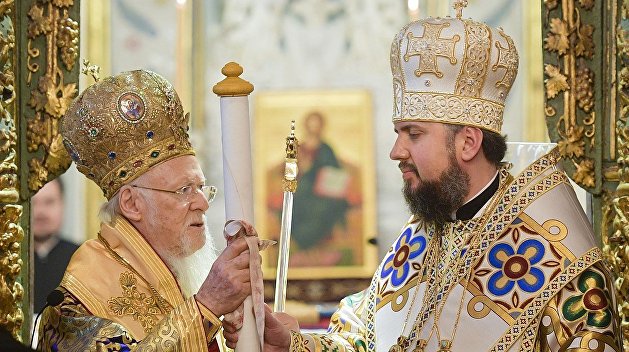
On January 5, 2019, His Holiness Ecumenical Patriarch Bartholomew signed the Tomos on the Autocephaly of the Orthodox Church of Ukraine. “The pious Ukrainian people have been waiting for this blessed day for seven centuries,” Patriarch Bartholomew said after the signing. On January 6, 2019, in the Church of St. George at the residence of the Ecumenical Patriarchate in Constantinople, during the festive liturgy with the participation of Patriarch Bartholomew, the Primate of the Orthodox Church of Ukraine Metropolitan Epiphanius was presented with a Tomos on the Autocephaly of the Ukrainian Church. On January 9, all members of the Synod of the Patriarchate of Constantinople signed the Tomos, which formally completed the process of obtaining autocephaly by the Local Ukrainian Orthodox Church.