The spiritual meaning of the Sacrament of Holy Communion
The sacrament of Anointing, or Conciliation, in our temples most often takes place during Lent, but can also take place on any other day of the church year. During the Council, an Orthodox Christian anointed priests seven times (ideally there should be seven, but the Sacrament is often served by one father) with consecrated oil mixed with red wine. At the same time the Gospel is read many times, prayers for the sick are heard. All this is happening for the healing of the soul and body of the Christian. Thus, in the Anointing, in the conciliar church prayer and in the anointing of a person with consecrated oil and wine, the sick Christian receives the grace of God, capable of healing both his physical and spiritual ailments.
According to St. Nicholas Kavasila, “The sacrament of the oil … receives the shrine and gives healing from physical illness and forgiveness of sins.” Sometimes it is heard that in the Sacrament of Anointing a person is forgiven of forgotten sins; however, it should be borne in mind that this is more a popular idea of the meaning of the Sacrament, rather than a doctrine rooted in the liturgical or ancient patriarchal church tradition. Although it should be remembered here that the Anointing is directly connected with the Sacrament of Penance (as well as with the Sacrament of the Eucharist), it is certainly clearly penitential, because it leads a person to healing from slavery. of sin. It is in this sense that the Sacrament of Anointing leads a person to forgive sins.
The Sacrament of Holy Communion is not a simple blessing before death, as it is sometimes understood in our Orthodox Church and as until recently it was officially considered in the Catholic Church (where this Sacrament was even called “the last anointing”, however, many Catholics still think) .
The sacrament of Anointing serves to restore and revive man to life. It is called to heal people from both physical and spiritual death: to protect both from the death of the body and from the death of the soul – as a deified man, as his deprivation of action sanctifies the Divine grace. This Sacrament is also called to free man from his sinful state, thus saving him from the same death, because the cause of both our physical and our spiritual death is sin.
In the Sacrament of Holy Communion, a common priestly prayer is performed, addressed to the Lord, the Mother of God and all the saints. Ultimately, however, the conciliar prayer for a Christian is not limited to the intercession for him before God by only seven priests. The priests ask for the intercession of the whole Heavenly Church for the person before Christ – and already the whole Triumphant Church ascends to God in its prayer for this Christian, asks the Lord for his healing.
Everyone who participates in this Sacrament, a seriously ill person, certainly realizes that he is not likely to necessarily receive physical healing in the conciliar and may very soon still die. But even in this case, if the sick have accepted the grace of the Sacrament with dignity, with faith and humility, he finds, thanks to the Anointing, another special gift, a special ability: in a new way, steadily and gratefully, to perceive his deadly disease, to approach the entering eternal life. Both illness and suffering are made for him then glorify, transform, become one of the gracious conditions of his Salvation. And this is because man, suffering – and suffering in Christ, sympathizing with the Lord, crucifying with Him and thus connecting with Him – is truly purified and sanctified. Physical death is no longer so terrible for those involved in the gathering of man: after all, going down to the Cross with the Lord, he overcomes much more terrible than physical death – spiritual death, the death of the soul, thus finding eternal life in Christ.
At the completion of the Sacrament of the Conciliation, the Divine will is determined for man: whether he should be healed or die. Some experienced priests do not recommend uniting a person twice over the same disease: he has already felt God’s will once, and the Lord has already made His definition of man. And further man has to accept this Divine will only and, following it, to carry out the work of his salvation.
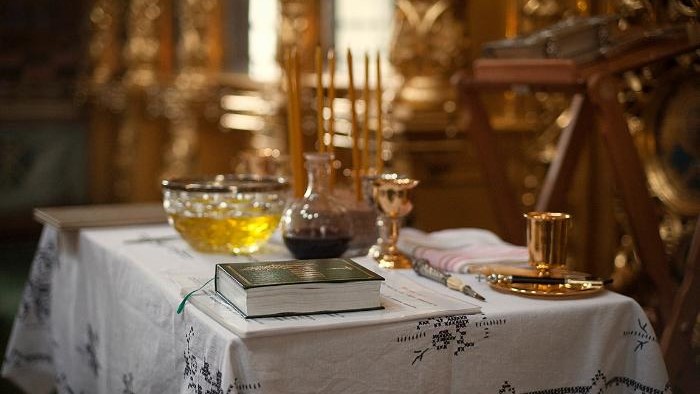
A few words should be said about the symbolic meaning of the substances used in the Sacrament of Anointing. The spiritual symbolism of the oil used in the Church has already been discussed in detail in connection with the Sacrament of Baptism. In the Sacrament, the gathering of fir trees is a symbol of church prayer and at the same time a symbol is poured out on the patient of Divine mercy. Wine and oil are also symbols of healing that heals the sick. As you know, both of these substances were used in ancient times in medicine – it was believed that wine disinfects wounds, and oil has an analgesic effect (remember the parable of the Good Samaritan: the wounds of a man injured by robbers were spruce and wine). The Sacrament of Penance also uses grain poured into a vessel: into which it is customary to insert seven burning candles. These grains serve as a symbol of new life, and a symbol that has a double meaning, a double spiritual reading – depending on what fate befalls a sick person in the future. If he recovers, then the grains for him mean the germinating new life to which he is reborn. If he dies, then these grains become a symbol of the pledge of future new life in his coming resurrection from the dead.