The Sacrament of the Eucharist (Communion) is the central sacrament of the Church. Having united with the Church – the body of Christ through Baptism, the Orthodox Christian becomes ready to fill his body with the saving presence of God the Son.
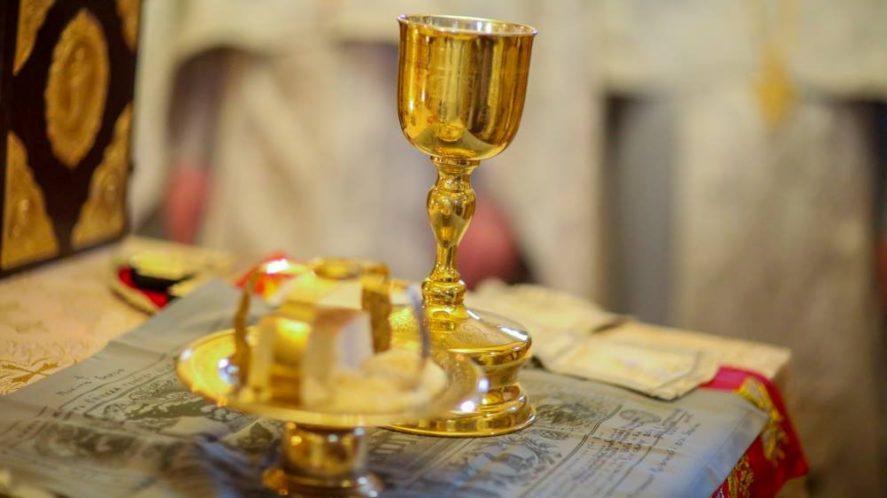
In the spiritual life, as in our earthly bodily life, we need to receive food. During the sacrament of the Eucharist, accepting bread and wine from the hands of a priest or bishop, we receive the true Body and Blood of Christ for the remission of sins and into eternal life. “Truly, truly, I say to you, unless you eat the Flesh of the Son of Man and drink His Blood, you will not have life in you … He who eats My Flesh and drinks My Blood abides in Me, and I in him.” (John 6: 53.56).
The Church has always understood and taught that the Holy Spirit descends during the liturgy and changes the bread and wine into the true Body and Blood of Christ, and that this cannot be understood only figuratively. The moment of the liturgy, during which the transfiguration of the gifts takes place, is called Epiclesis, the invocation of the Holy Spirit. “Send down your Holy Spirit on us and on this present gifts. And create this bread – the honest Body of Thy Christ, and in this chalice – the honest Blood of Thy Christ, having transferred it by Thy Holy Spirit. Amen, amen, amen. ”
This prayer of the priest at the liturgy is a call to God the Father to sanctify the bread and wine we have brought and to make possible the presence among us of the incarnate and risen Son of God Jesus Christ by the power of the Holy Spirit. Before his death on the cross, Jesus himself established this Sacrament, commanding his disciples to do it in remembrance of Him (1 Cor. 11: 23-26). At the Last Supper, Jesus served a sacrificial meal as an image of His passions for our salvation. “And while they were eating, Jesus took the bread and, having blessed it, broke it and, distributing it to the disciples, said: take, eat: this is my body. And taking the cup and giving thanks, he gave it to them and said: Drink from it, all of you, for this is My Blood of the New Testament, which is shed for many for the remission of sins ”(Matt. 26: 26-28).
The sacrament of the Eucharist is the center around which the whole life of the Church revolves. This is our participation in the sacrifice of Christ. By offering the gifts of bread and wine “in remembrance of Him,” we become members of the royal priesthood (1 Peter 2: 9). Christ’s only and self-sufficient sacrifice is constantly actualized on the altar table, allowing us to participate in the atonement that He has already given to us.
During the divine liturgy, we give thanks to God for everything that He has done for us to be reunited with Him. Such retribution is called the Eucharist (Greek evcharistia) – thanksgiving. This is our gratitude to God in the form of bread and wine, which become the true Body and Blood of our Savior Jesus Christ. Our attempt to thank God for all His good deeds leads us to communion with Him, partaking. For the sake of our salvation, we cannot do anything more than this: God, according to His will, did everything for us.
The sacrament of the Eucharist, that is, the presence of Christ in our midst, is the completion of our journey to reunification with God.
While partaking, we unite in the closest way with Christ – He dwells in us and we in Him. Therefore, we must approach the Sacrament as often as possible. Church rules dictate communion at least four times a year, usually during fasting. A person who does not receive Communion at least once a year separates himself from communion with the Church.
Due to the importance of the sacrament of the Holy Eucharist, it is necessary to prepare very carefully for the reception of the Holy Gifts: fasting, examination of one’s conscience and confession are integral elements of preparation. We are never worthy to receive Holy Communion, but since Christ accomplished our salvation, we only have to prepare as thoroughly as possible for the union with Him in the Sacrament of the Eucharist.