Practical guidelines for the episcopate, clergy and faithful of the Orthodox Church of Ukraine in connection with the declared pandemic of a particularly dangerous coronavirus disease (COVID-19).
Supplemented in accordance with the decisions of the Holy Synod of March 24, 2020 and April 9, 2020.
The following guidelines, approved by the Holy Synod, are intended to:
– to testify to the Church’s concern for all her children, both strong and weak in the faith, to share with the people the burden of forced restrictions, remembering the Scriptures: “Bear one another’s burdens, and so fulfill the law of Christ” (Gal. 6: 2);
– to help the most vulnerable part of society, the elderly and the elderly, to stay at home during the devastating plague, in the safest conditions, because we place all our hope in the mercy and help of the Lord, but we also remember warning: “Do not tempt the Lord your God” (Luke 4:12);
– to testify that our restrictions on the order of worship and other changes and restrictions in church life are a manifestation of the strength of our faith, not its weakness, following the example of the centurion who said: “Lord, I do not consider myself worthy to come to you. ; but speak only the word, and my servant shall be healed, “for which he was honored by the words of the Savior:” I tell you that even in Israel I have not found such faith “(Luke 7: 2-10);
– to beware of the zeal of relying on one’s faith, as was the case with the Apostle Peter, who first walked on the waters and then began to drown (Matt. 14: 23-32), promising to remain with the Savior if even all left Him, and then denied Him three times (Matt. 26: 33-35,75);
– “Do not give occasion to those who seek occasion” (2 Cor. 11:12), for the Scriptures call:
1. To take into account and comply with legal regulations, orders and quarantine restrictions imposed by the state, local governments and health authorities, to prevent both ignoring the real danger and panic.
2. To accept the changes and limitations caused by the spread of the disease as an ascetic feat of restraint and self-restraint from communication (shutter), the essence of which coincides with the purpose and practice of fasting, remembering the Savior’s words: “When you pray, enter your room and close your door. pray unto thy Father which is in secret, and thy Father which seeth in secret shall reward thee openly ”(Matthew 6: 6).
3. As a temporary emergency measure, showing concern for the faithful, depending on the restrictions imposed by public authorities and local governments, in particular on the movement and operation of public transport, restrictions on the possible number of simultaneous gatherings of a certain number of persons (on 17.03.2020 – not more than 10 people) – to stop conducting services in temples or to change the order so that no more than a limited number of people take part in them.
Priests and clergy, readers and singers, other persons involved in the performance of services and broadcasting (if any) must be present during the services in the temple – a total of no more than 10 people; The national police explained that they would consider both the presence of a larger number of people in the temple and the presence of worshipers in the areas near the temples in the open air in any number to be a violation of quarantine norms, for which they considered it possible to prosecute.
Introduced on April 6 this year quarantine regulations impose a general obligation to use protective equipment (masks, respirators) in public places. According to the National Police, this norm applies to clergymen and singers for the duration of their service.
Divine liturgies are held in the presence of a limited number of people, asking the laity to stay at home, joining the common prayer through video broadcasting. Those wishing to confess and receive communion can do so throughout the day, subject to the conditions of preparation. Pastors should show due diligence in each case.
At the time of the introduction by the state, authorities and local self-government of special enhanced restrictions on freedom of movement and freedom of assembly, during these enhanced restrictions temporary permission is granted to worship in churches only to clergy and clergy and singers, without the personal presence of the laity. During such services, the laity should participate in common prayer, using the possibility of remote communication (media broadcast).
4. During the day, churches should be open for personal visits and prayer, communication with clergy, observing general rules. Strengthen anti-epidemic security measures in churches, use disinfectants, including to maintain the cleanliness of icons and other shrines.
For the explanation of the National Police at the time outside of the service in churches, more than two people (not counting the clergyman) should not be at the same time – in a large church, and more than one person (excluding the clergyman) – in a small church, outwardly no queues should form.
5. At the time of a pandemic, a sufficient manifestation of respect for shrines (Cross, icons, holy relics) is worship / bow before them, without kissing; indicated also applies to personal greetings and expressions of respect between members of the Church, in particular between clergy and laity when giving a blessing. When giving a blessing with a cross, it is enough to make overshadowings with it, without kissing.
6. Temporarily not to transfer relics (holy relics, revered icons) from their permanent storage sites, not to organize pilgrimages.
7. As a temporary extreme measure, it is allowed to read the faithful of the Body and Blood of Christ in the same way as it is done by the clergy during the Liturgy of the Presanctified Gifts, namely: prepared slices of the Body, on which a part of the blood was laid by the liar (as is done when preparing spare Gifts) serve from the diskos into the hands (or a liar without touching the lips) to the communicant. In doing so, one should carefully explain the responsibility of the participants to use the Gifts carefully. Use disposable wipes to wipe your lips, and then burn them in a clean place. Use disposable tableware for drinking after taking Communion, or consume only antidor.
The Church invariably maintains a special attitude towards the Eucharist, the sacrament of the Body and Blood of Christ, as a Sacrament, which is given “for the healing of the soul and body,” and not as the consumption of food (1 Corinthians 11: 20-30). The use of the same method for the sacrament of the laity, and for the clergy, is dictated by the concern for the weak in the faith (Rom. 14: 1-13) and that the Sacrament and the Church should not be subject to groundless shame from outsiders.
8. Permit to give the Communion as spare Gifts to all who apply for this, at any time, as is done in relation to the sick and in mortal danger.
9. In the implementation of the Sacrament of Confession, taking care of neighbors and in order not to give rise to temptation, adhere to the maximum of the general rules of “social distance” and the above attitudes and allow the practice of general confession.
10. Taking into account the restrictions on the possibility of simultaneous meetings, not to hold general Councils, but to give this Sacrament individually especially to those in need, in accordance with its meaning and tradition.
11. The sacrament of Baptism and the rite of burial should be carried out in compliance with general restrictions regarding the number of those present.
When carrying out burial, the following recommendations of the Ministry of Health should be observed:
– admit no more than 10 persons present, provided they are simultaneously in the room;
– the location should be no more than 1 person per 10 square meters of area;
– a safe distance of 1.5 meters between those present must be maintained;
– it is forbidden to kiss the body of the deceased due to the risk of infection.
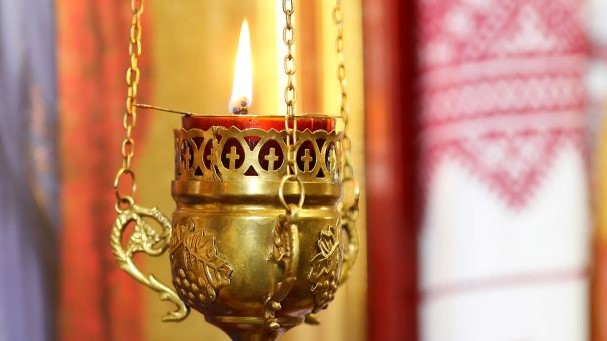
12. Since lay believers are temporarily limited in their ability to physically participate in church services, they are advised to organize in their homes a prayer corner with icons, the Holy Scriptures (Bible), a prayer lamp (lamp) or a candle, a prayer book, to pay more attention to personal prayer in the morning in the evening and during the day, reading spiritual and edifying books, manuals and sermons (including those posted on pages on the network). Viryans are encouraged to read Holy Scripture, especially the Gospel, prayer reading of the Psalter, Akathists of the Most Holy Theotokos, Holy Great Martyr and Healer Panteleimon and other saints, with the frequent raising of Prayer during a pernicious epidemic (epidemic), approved by the Holy Synod. Those who wish are encouraged to offer a simultaneous prayer daily at 21 pm Kiev time.
While at home and participating in the service through the broadcast, the faithful should listen to the service and pray in front of the icon, being in the house like in a temple, observing the usual rules for participating in the temple service, and not allowing the broadcast of the service to be treated only as a revision of the spectacle.
13. At the request of believers, the priest visits their homes for spiritual conversations, Confessions and Communion, using the appropriate entry. Spovid and Communion for sick believers in the hospital are carried out in accordance with the rules of the hospital. In case of a ban on personal communication, the priest can conduct a spiritual conversation and pray for the patient’s health, using means of communication, placing his hope in the mercy of God.
When performing the Sacraments of Confession and Communion in the homes, the following measures should be observed: at the entrance the priest should use disposable shoes (boot covers) and a sanitary mask, wash his hands with soap and water, use disinfectant. The relic, the epitrachel, the cross, and the liturgical set for the Eucharist of the sick should be kept clean.
14. Clergy and clergy who show symptoms of coronavirus disease (COVID-19) or come into contact with a person diagnosed with coronavirus, inform their spiritual guidance (abbot, deacon, diocesan bishop) and health authorities. I follow the established procedures (self-isolation, quarantine, etc.)
These guidelines can be changed and supplemented as the situation develops, for as the Lord Himself taught us, “the Sabbath is for man, not man for the Sabbath” (Mark 2:27).